
API · EMBED · WHITE-LABEL · REST API
Build an LMS API. Embed one instead
uQualio’s API and embed layer gives your app complete video microlearning: course delivery, progress tracking, quizzes, certificates, and analytics, without 12 months of infrastructure work. Ship your product. Not the LMS underneath it.
No code · No hassle · Plans from $19.99/month
From API key to live video learning in 3 steps
Connect uQualio to your app once. Course delivery, learner tracking, and certificates work immediately
– no LMS infrastructure to build or maintain.
01
Build your courses with AI in uQualio
Use uQualio’s course builder to create your content. Upload or import from available video sources, add quizzes, structure lessons, configure pass marks and certificates.
No LMS from scratch. Your content infrastructure is done.
02
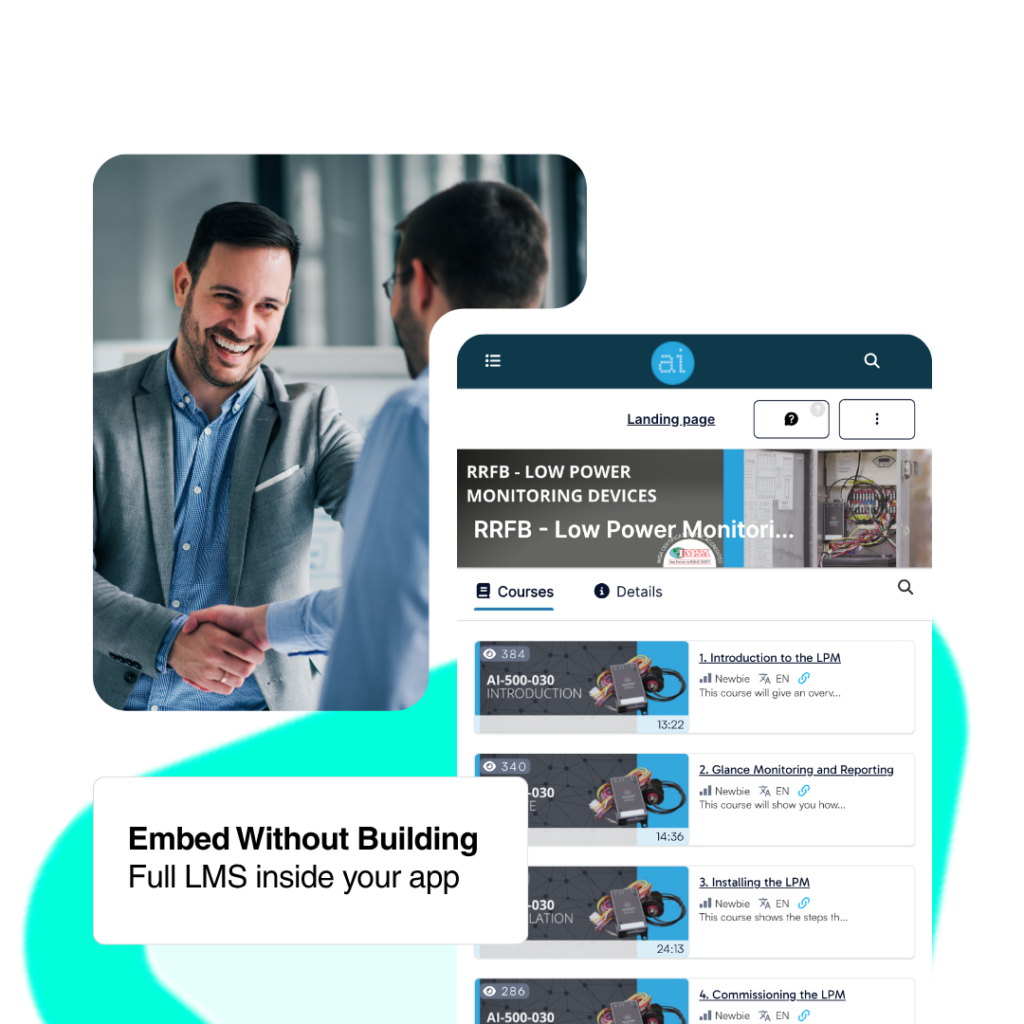
Connect via API or drop in an embed
Use the REST API to programmatically enroll learners, retrieve progress, and trigger certificate issuance from your own backend.
Or embed the white-label course URL directly. No API work needed for a working integration.
03
Go live. Completions tracked. Certificates issued
Deploy and let uQualio handle the learning infrastructure. Query to follow completion, certificate earned, and quiz passed. Your app reacts in real time.
Analytics available via API or uQualio’s dashboard.
How it works
Building with Vibe Coding? Plug Learning in with uQualio embed and API
API reference
The endpoints your app actually needs
Everything required to deliver video learning inside your product. Clean REST endpoints, predictable responses, and webhook events for real-time reactions.
Enroll a learner in a course
Method: POST
/v1/enrollments
courseId string required
learner.email string required
learner.name string optional
webhookUrl string optional
→ { courseUrl, status, expiresAt }
Get learner progress & completion
Method: GET
/v1/enrollments/{enrollmentId}/progress
→ {
percentComplete: 84,
quizScore: 92,
passed: true,
certificateUrl: “https://…”
}
Integration options
Two ways to integrate. Pick what fits your stack
Whether you’re shipping a quick embed or building a fully custom learner experience, there’s a path that fits.
- Number 1: Embed URL (zero backend work)
Paste a white-label course URL into your app. Learners complete the course inside your product. Progress syncs back automatically. Done in hours.
- Number 2: REST API (full control)
Programmatically enrol learners, retrieve progress, react to completion webhooks, and surface analytics inside your own UI. Full LMS behaviour, none of the infrastructure cost.- JWT authentication: Learners sign in with your app’s identity, not a separate uQualio account
- Query to get updates on: Completed, quiz passed, certificate issued
- White-label or Headless embed: Zero uQualio branding visible to your learners
- Analytics API: Pull completion rates, quiz scores, and engagement data into your own dashboards
Video sources
Many video sources.
Connect what you already use
- Synthesia
- Colossyan
- Elai.io
- Vimeo
- YouTube
- TwentyThree
- Kaltura
- VIXY
- Whereby
- Direct Upload
Vibe coding
You're building apps faster than ever. Your LMS should keep up.
AI-assisted coding has collapsed the time it takes to ship a product from months to days. The bottleneck is no longer writing code – it’s the infrastructure decisions underneath it.
An LMS is one of the hardest pieces of infrastructure to build correctly: Video delivery, progress state, quiz logic, certificate generation, multi-tenant isolation, analytics.
uQualio handles all of it via API so you can spend your next sprint on the thing that actually differentiates your product, not on building a course player and a certificate PDF generator.
Webhooks
For SaaS companies that want onboarding completion to trigger something in their product:
When a customer completes your onboarding course, the course.completed webhook fires. Your backend receives the event – learner email, course ID, pass/fail, certificate URL. What happens next is yours to define: mark the account as activated, trigger the invoice, unlock a feature, update the CRM record, send a success email from your domain.
DORA moved from 3-hour in-person onboarding visits to invoicing customers immediately after the sales meeting – because the training was handled and tracked before the customer touched the product.
The API is what makes that connection possible.
Why embed rather than build
12–18 months of LMS development.
Or one API call
Building a video LMS from scratch means video hosting, adaptive streaming, progress state management, quiz engines, certificate generation, and compliance reporting. uQualio solves all of it.
Get started
Your app needs a video LMS. You don't need to build one!
Start your free trial, get your API key, and have a working video course inside your app before the end of the day. Free, no-risk 14-day trial.
Everything a developer needs to know about the uQualio API
- Can I embed uQualio video courses into my own application?
Yes. uQualio offers two integration paths.
The first is an embed URL, a white-labelled course URL you drop directly into your application as an iFrame or redirect. Learners complete the course inside your product experience with no uQualio branding visible.
The second is the REST API, which gives you programmatic control over enrolment, progress retrieval, certificate issuance, and analytics, so you can build a fully custom learner UI while uQualio handles the backend learning logic.
Both approaches include completion tracking and certificate generation.
- Does uQualio have a REST API for course management and learner tracking?
Yes. uQualio’s REST API covers the core learning lifecycle: course management, learner enrolment, progress tracking (percentage complete, quiz scores), completion events, certificate issuance, and analytics.
Webhooks fire on key events —
course.completed,quiz.passed,certificate.issued— so your application can react in real time without polling. - How long does it take to integrate uQualio's API into an existing app?
Most developers ship a working integration in one to three days. The embed URL approach typically takes a few hours. A full REST API integration covering enrolment, progress tracking, webhook handling, and certificate display generally takes two to three days of focused development. This compares to 12–18 months of engineering work to build equivalent LMS infrastructure from scratch: video hosting, adaptive streaming, quiz engines, progress state management, certificate generation, and more.
- What is a headless LMS and does uQualio support it?
A headless LMS provides the backend learning infrastructure: The course storage, learner data, progress tracking, certificates, analytics, via API, without a fixed frontend UI.
Developers build any learner interface they want; the LMS handles the data. uQualio supports this approach via its REST API.
You can build a completely custom learner experience in your own product and design system while uQualio manages all learning state and logic on the backend.
- Does uQualio support SSO?
uQualio supports JWT-based authentication, which allows your application to pass a signed token to uQualio that identifies the learner. Learners never see a separate uQualio login. They access courses using your application’s existing identity.
Note: uQualio does not currently support native SAML/OIDC SSO. If your enterprise requires SAML-based SSO, contact the team to discuss the JWT approach and whether it fits your use case.
- Does uQualio support SCORM or xAPI?
No. uQualio does not currently support SCORM or xAPI. If your integration requires SCORM compliance, typically for government, defence, or regulated-sector procurement, uQualio may not be the right fit.
For most modern web application integrations, the REST API and webhooks provide more flexible and developer-friendly access to the same completion data.
- What video sources can I use with the uQualio API?
uQualio integrates with multiple video sources, including Vimeo, YouTube, Kaltura, TwentyThree, VIXY, and direct file upload. AI-generated video from Synthesia, Colossyan Creator, and Elai.io can also be connected directly.
Courses built via the uQualio API can draw from any video content your team produces, regardless of where it’s hosted.
- Does uQualio support multi-tenant configurations?
uQualio supports separate course environments per customer from one integration, incl. isolated learner data, separate branding, and independent analytics per customer.
Contact the support team to confirm the right configuration for your specific tenant isolation requirements before committing to an architecture.
- Is the uQualio API suitable for AI-assisted development?
Yes. The API is REST-based with JSON responses, clear webhook events, and straightforward JWT authentication.
The embed URL option requires no backend work at all.
For developers building with AI coding tools: Cursor, Lovable, Bolt, v0, or similar, describe the integration to your coding assistant, paste in the API reference, and the enrolment and progress tracking logic writes itself.
- How do I get started?
Start a free 14-day trial and see if you like the platform. If you do, then buy a month subscription incl. API access.
Create your first course, find your API key in developer settings, and make your first API call in minutes.
The integration guide and API reference are available inside the platform.
Contact the team to book a developer onboarding call if you need help scoping your specific integration.