
Video-based learning
People are 75% more likely to watch a video than read a document
Microlearning with videos under 5 minutes, each followed by a knowledge check, outperforms hour-long sessions on every retention metric. uQualio is built for exactly this.
No code · No hassle · Plans from $19.99/month
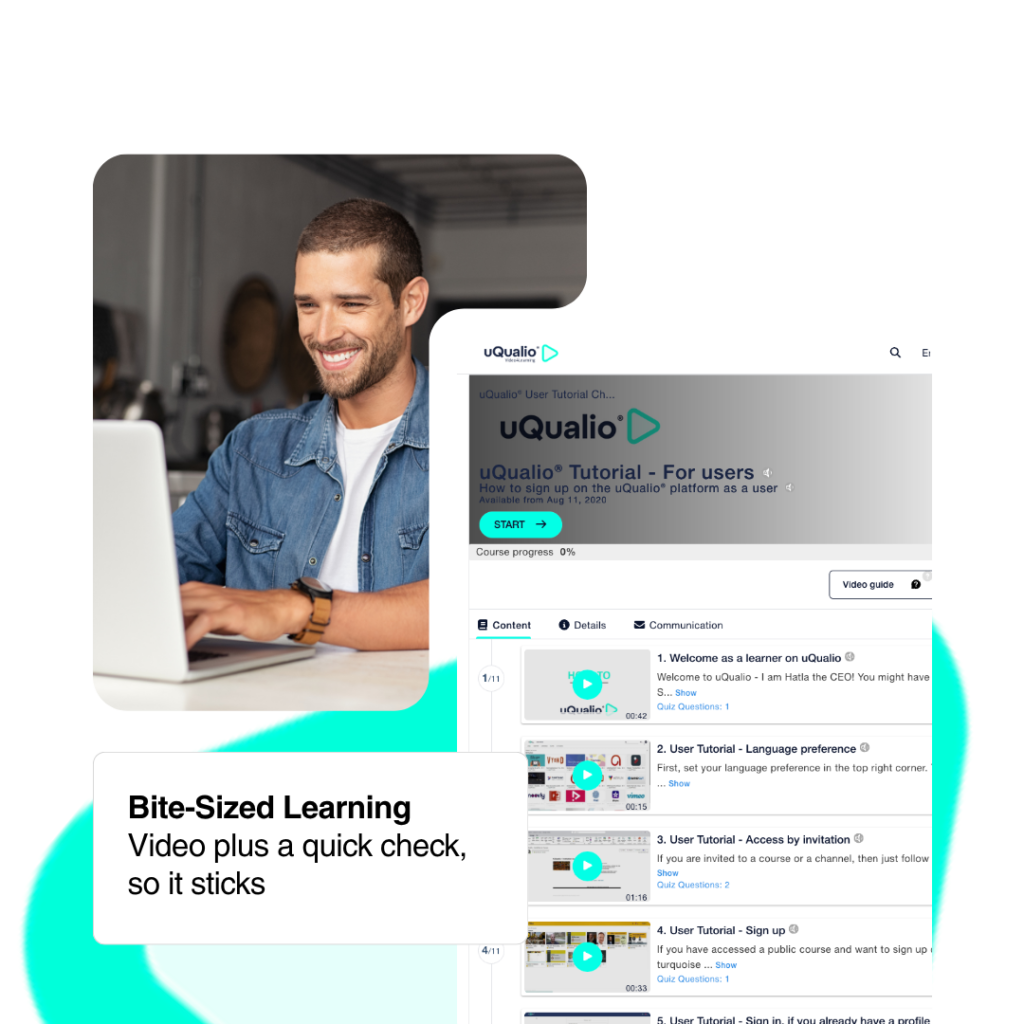
Video-based learning
Where video-based learning delivers
Video-based microlearning works wherever knowledge needs to reach people who aren’t in the room, e.g. partners, customers, field teams, and contractors, but also employees.

Partner & channel training
Turn every partner into your best partner
Your partners need to understand the product before they can sell it. A 5-minute product walkthrough, quizzed and tracked, reaches every dealer in their own language, without flying a trainer to each region.
Customer onboarding
Know they’re ready before you invoice
Recorded walkthroughs of your onboarding process are already video-based learning. uQualio adds the quiz, the certificate, and the completion tracking, so you know customers are ready, not just that they clicked play.
Compliance training
Documentation that holds up to audit
A quizzed video course with a certificate and a timestamped audit trail is defensible documentation. When a regulator asks who completed mandatory training and when, the answer is in the dashboard, not scattered across inboxes.
Employee training
Get knowledge out of one person’s head
Product launches, process updates, new hire onboarding – any knowledge that lives in a subject matter expert’s head and needs to reach everyone else is a candidate for a 5-minute video course. Record once; reach everyone.

For services & implementation teams
For teams running onboarding walkthroughs dozens of times a year
Record it once. uQualio adds the quiz and the completion certificate. New customers get the link with their invoice and work through it before the first call. Your team handles the exceptions — not the repetition.
Why video beats text for procedural knowledge
Your dealers, customers, and partners don’t read training documents. Not because they’re disengaged but because a PDF showing how a product works is no substitute for seeing it.
Video is how people learn procedures. A 5-minute walkthrough of a configuration step is retained far longer than the same content in text. Studies consistently show that people retain significantly more from a message delivered via video compared to reading the same content in a document.
The Ebbinghaus forgetting curve is the underlying mechanism: without reinforcement, people forget roughly 70% of new information within 24 hours. A short video with a knowledge check interrupts that curve. A PDF doesn’t. The quiz isn’t just a test. It’s the reinforcement event that makes the video stick.
Shorter sessions outperform longer ones
A 60-minute training session covers 12 things. Learners leave remembering three. A 6-module microlearning course covers the same 12 things in focused chunks — and the quiz after each one tells you exactly which three they missed.
This is the difference between “they attended the session” and “they’re ready.”
What microlearning is and why session length matters
Microlearning isn’t just “shorter videos.” It’s a deliberate structure: one concept per module, preferably under 5 minutes, followed by a knowledge check that reinforces what was just covered.
The evidence for this is consistent across learning science research. Learners who watch a focused 5-minute video and answer three questions outperform learners who sat through a 60-minute session and took nothing away but a completion log.
Spaced repetition, the returning to material in short sessions over time, rather than one long session, is the most reliable mechanism for long-term knowledge retention. Microlearning is what makes spaced repetition practical at scale.
The gap between "they watched it" and "they know it"
Video alone doesn’t prove readiness. A learner who clicked play and left the tab open has a 100% completion rate. A learner who watched carefully but failed every question has the same rate.
uQualio closes that gap. Tracking video views is the starting point, not the finish line.
How it compares
uQualio vs. video link or shared folder
Sharing a video is not training. Here’s what changes when you add a quiz, a certificate, and analytics.
| Video-based learning | uQualio | YouTube / Vimeo link | PDF or slide deck |
|---|---|---|---|
| Completion tracking | ✅ Per user, real-time | View count only | ❌ None |
| Knowledge check | ✅ Built-in quiz | ❌ None | ❌ None |
| Certificate on completion | ✅ Branded PDF, with expiry | ❌ None | ❌ None |
| 30+ language translation | ✅ AI, from one recording | Manual re-record | Manual translate |
| Access control | ✅ Private / public / invited | Link sharing only | File sharing only |
| Automated reminders | ✅ Email and SMS built in | ❌ None | ❌ None |
| Update without breaking links | ✅ Permanent links always current | New link on each upload | Version confusion |
| Audit trail for compliance | ✅ Timestamped, exportable | ❌ None | ❌ None |
Get started
Turn your first video into a tracked course - Free
No studio. No script. No IT project. Record a 10-minute walkthrough on your phone, upload it to uQualio, and publish a quizzed, tracked course before the end of your trial. Most users are live within the first hour.
Questions about uQualio's video-based learning
- What is video-based learning?
Video-based learning is a training approach that uses video as the primary content format. Unlike text-based training, it shows rather than describes, making it especially effective for procedural knowledge: how to operate a product, configure a system, follow a process, or demonstrate a skill. The most effective video-based learning pairs short video modules with knowledge checks that reinforce what was just watched.
- What is microlearning?Microlearning is a training structure built around short, focused modules or topics, typically under 10 minutes, each covering one concept and followed by a knowledge check. It’s grounded in learning science research on spaced repetition and retrieval practice: returning to material in short sessions over time produces significantly higher retention than a single long session covering the same content.
- How is uQualio different from sharing a YouTube or Vimeo link?A video link shows a view count. uQualio shows who watched, what they scored, whether they passed, and whether their certificate has expired. You can message non-completers directly from the dashboard, set access controls so only invited learners see the content, and auto-translate the course into 30+ languages from one recording. Sharing a video link is not training, it’s broadcasting. But you can turn your YouTube video into a microlearning – learn more here.
- Do I need a professional video studio?
No. The most effective training videos are recorded by the person who knows the subject best: your product specialist, your implementation lead, your applications engineer. A phone camera works fine. uQualio transcribes the video, generates quiz questions from the transcript, and translates them into 30+ languages on demand. You review and publish. Most first courses are live within an hour of signing up.
- How many languages does uQualio support?uQualio supports 18+ interface languages for the platform itself and AI Dynamic Translation into 30+ languages for course content. Translation covers subtitles, quiz text, and the learner interface. All selectable by the learner at view time. You record once; every learner gets the course in their own language without you re-recording anything.
- Can I track who watched my training video?Yes – and much more than that.uQualio tracks per-user completion status, quiz scores, pass/fail status, certificate issuance, and number of times accessed. You can view this in real time from the dashboard or export to Excel for compliance documentation. You can also message non-completers directly from the report view without leaving the platform.
- What types of quizzes can I add to a video course?uQualio supports three question types: single-choice (one correct answer), poll (no right answer – useful for gathering feedback), and open text (written response). AI generates quiz questions automatically from the video transcript, which you can edit before publishing. You can configure separate practice questions and final test questions, and set a minimum pass threshold for certificate issuance.
- How long does it take to publish a video course?Most uQualio users publish their first course within 30–60 minutes of signing up. Upload the video, review the transcript, AI-generate quiz questions and more, set your pass threshold, and publish. No IT involvement. No design team. No instructional design experience required.